

 Nurpur, Himachal, INDIA

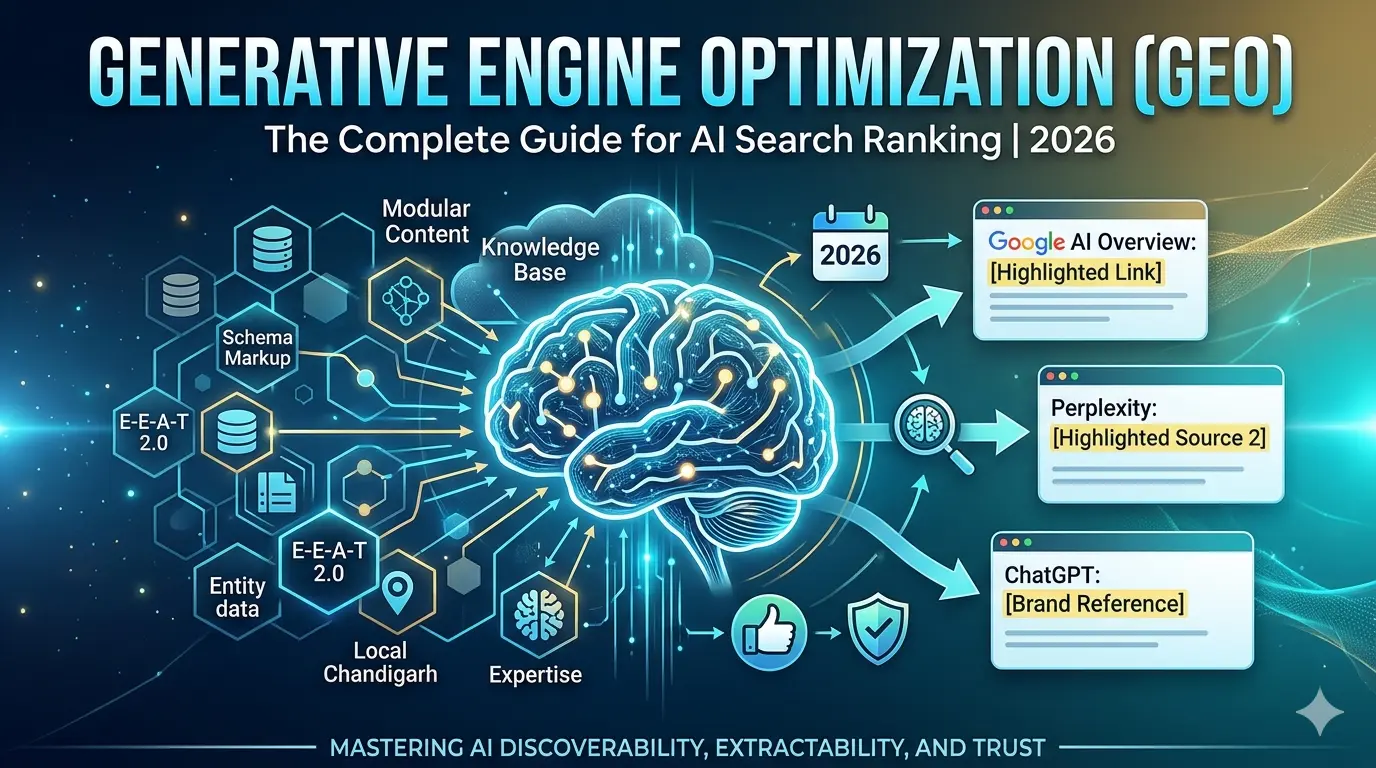
Generative Engine Optimization (GEO) is the practice of optimizing digital content to be cited, referenced, and recommended by AI-powered search engines and Large Language Models (LLMs) like Google AI Overviews (SGE), Perplexity, ChatGPT, and Gemini. It serves as tool of direct answer to the queries instead of displaying out the bunch of list. Growing adaptation of AI tools make it significant to get referenced in AI search engines to grow your business online and expand the reach.
In 2026, SEO is no longer just about ranking #1 in a list of blue links; it is about becoming the “Source of Truth” that an AI uses to synthesize its answer.
SEO vs. GEO: The Strategic Shift
While traditional SEO focuses on driving clicks to a website, GEO focuses on AI visibility and brand citations.
| Feature | Traditional SEO | Generative Engine Optimization (GEO) |
| Primary Goal | Rank #1–3 for specific keywords. | Be the cited source in an AI’s answer. |
| Success Metric | Click-Through Rate (CTR) & Traffic. | AI Visibility Score & Citation Frequency. |
| Content Unit | The entire webpage. | Modular “Information Chunks” (standalone sections). |
| Algorithm Focus | Keywords and Backlinks. | Semantic Meaning, Entities, and E-E-A-T. |
| Outcome | User visits your site. | AI recommends your brand/product to the user. |
Core Pillars of GEO in 2026
To rank in generative engines as Gemini, Chat GPT, Copilot, GROK, Perplexity etc, your content must satisfy three main criteria: Discoverability, Extractability, and Trustworthiness.
A. Modular Content Architecture
AI engines don’t “read” your whole page to show a link; they extract specific facts about what the page is about and the search queries it can serve.
- Standalone H2s: Every subheading should be a complete answer. If an AI pulls only that section, it should still make sense.
- Sentence Brevity: Keep key claims under 20 words. LLMs favor concise, “snackable” data points for synthesis.
- The “Rule of One”: One paragraph should provide one clear fact or answer.
B. Entity-Based Optimization
AI understands the world as a web of “Entities” (People, Places, Brands). It takes into account if the query is asking for people or organization or a particular thing, channel etc.
- Schema Markup: Use Organization, Product, and FAQ schema to define exactly who you are and what you do.
- Consistent Naming: Use the exact same brand and product names across your site, social media, and third-party directories.
- Wikidata & Knowledge Graphs: Getting your brand into open-source databases helps AI engines verify your existence as a trusted entity.
C. E-E-A-T 2.0 (Experience & Evidence)
In a world full of AI-generated content, engines prioritize human unique signals.
- Original Data: AI loves citing “According to a 2026 study by SEOWORLD AI
- Personal Perspective: Use “I” and “We” to describe first-hand experiences. AI models are trained to look for “lived experience” that a bot cannot replicate.
- Third-Party Citations: Being mentioned on Reddit, niche forums, or industry news sites acts as a “vote of confidence” for the AI.
Platform-Specific Strategies
- Google Gemini / AI Overviews: Focuses on Google Maps integration and high-authority blog content. Ensure your local “Google Business Profile” is 100% optimized.
- Perplexity AI: Prioritizes Freshness. Perplexity often cites news and updated data. Refresh your key commercial pages every 30 days.
- ChatGPT (Search): Favors Direct Answers and conversational tone. Use FAQ sections that mirror how people naturally speak into a microphone.
How to Measure GEO Success
Since “Rankings” are fluid in AI, you need new KPIs:
- Citation Frequency: How many times does the AI mention your brand name?
- Sentiment Score: Is the AI describing your product as “affordable,” “premium,” or “best for beginners”?
- Share of Voice (SoV): In a “Top 10” AI list, how many spots do you occupy vs. your competitors?
Pro Tip: In 2026, the best GEO strategy is to stop writing for “crawlers” and start writing for “users” while using “machine-readable” formatting. If a human finds your content helpful and clear, an AI likely will too.
How are you currently tracking your website’s visibility in AI-generated answers?
How GEO works?
To understand how Generative Engine Optimization (GEO) works, you have to look at it as a three-step conversation between your website, the AI model, and the user. Unlike traditional search, which “indexes” your site, GEO is about helping an AI “digest” and “cite” your site. Here is the mechanical breakdown of how GEO functions:
The Retrieval Stage (Finding the “Chunks”)
When a user asks a question, the AI (like Gemini or Perplexity) doesn’t just look for a keyword. It uses Vector Search to find the most relevant “information chunks” across the web.
- How it works: The engine breaks your content into mathematical representations (vectors). It looks for content that is semantically close to the user’s intent.
- Optimization Trigger: If your content is buried in long, rambling paragraphs, the AI might miss the core fact. GEO works best when you use Short, Fact-Dense Sentences and Clear Headers (like your recent work with Product and Service schema).
The Synthesis Stage (The “Reasoning” Process)
Once the AI has “retrieved” several sources, it enters the Reasoning phase. It compares sources to see which one is the most authoritative and easiest to summarize.
- Weighting Evidence: The AI looks for citations and statistics. A sentence that says “Our taxi service is the best” carries less weight than “We have served 5,000+ customers with a 4.8-star rating as of 2026.”
- The GEO “Boost”: Research shows that adding technical terminology, statistics, and expert quotes significantly increases the likelihood of an AI choosing your site as its primary source.
The Citation Stage (Getting the Link)
This is the “GEO Win.” The AI generates its answer and places a small link or footnote.
- The “Contextual Link”: AI engines place citations based on Trust. This is where your Structured Data (Schema) plays a huge role. By using Rank Math or Yoast to clearly define your “Service” and “AreaServed” (like Northern India or Chandigarh), you make it mathematically easier for the AI to link your business to a specific query.
The “GEO Formula”
Researchers have identified specific “Levers” that make content more likely to be used by AI. Here is how they work in practice:
| Technique | What it does | Impact on Ranking |
|---|---|---|
| Cite Sources | Adding outbound links to high-authority sites. | +10% Visibility |
| Include Statistics | Replacing vague claims with hard numbers. | +15% Visibility |
| Expert Quotes | Adding a “Perspective” section from a professional. | +25% Visibility |
| Schema Accuracy | Using JSON-LD to define your business facts. | Essential for Local GEO |
Example: Traditional vs. GEO Content
- Traditional (SEO): “We offer the best taxi service in Chandigarh for Himalayan tours. Book now for great prices.” (Good for keywords, bad for AI).
- GEO Optimized: “According to 2026 travel trends, Himalayan routes like Spiti Valley require high-clearance vehicles. Chandigarh Tour Club provides SUV options with experienced mountain drivers, maintaining a 98% on-time record for Amb Andaura pickups.” (Excellent for AI because it uses Entities, Specific Data, and Context).
Since you’ve already been working with Service Schema and HTML sitemaps, you’ve laid the groundwork. The next step is ensuring your blog content (like your Manali or Leh itineraries) includes these “hard facts” and “expert quotes” that AI engines love to scrape.
Frequently Asked Questions about GEO (2026)
As of early 2026, Generative Engine Optimization has moved from a “nice-to-have” to an essential marketing layer. Here are the most common questions regarding how it impacts your digital presence.
1. Is GEO replacing traditional SEO?
No. GEO is an evolution and a layer on top of traditional SEO.
- SEO is still needed to get your content indexed and ranked by search engine crawlers.
- GEO focuses on making that content easy for AI models (like Gemini, ChatGPT, and Perplexity) to summarize and cite. Think of SEO as getting a seat at the table, and GEO as being the one who gets to speak.
2. Why is my website traffic dropping even though I’m being cited by AI?
This is known as the “Zero-Click” phenomenon. AI search engines often answer the user’s question directly in the chat interface.
- The Reality: Users may not need to click through to your site to get the answer.
- The Opportunity: While total traffic might decrease, the users who do click through are typically higher-intent and closer to a conversion because they are looking for the deep-dive details the AI couldn’t fully summarize.
3. How often should I update my content for GEO?
More frequently than before. AI engines prioritize freshness and current data.
- Evergreen Content: Update at least once every 6 months.
- High-Competition Topics: (e.g., “Best Taxi Service in Chandigarh 2026” or “Current Egg Prices”) should be updated monthly or even weekly to remain the “Source of Truth” for AI models.
4. What content formats does AI prefer for citations?
AI models are “pattern-matching” machines. They look for:
- Direct Q&A: Using H2 or H3 headers as questions followed immediately by a 40–60 word answer.
- Bullet Points & Tables: These are incredibly easy for AI to “scrape” and reformat into its own answer.
- Statistics & Evidence: AI loves quoting numbers (e.g., “98% customer satisfaction” or “Serving 15+ Himalayan routes”).
5. Can small businesses compete with big brands in GEO?
Yes. Unlike traditional SEO, where high “Domain Authority” (backlinks) is the biggest hurdle, GEO rewards Niche Authority and Specificity. If your content is the most current and specifically accurate source for a local topic (e.g., “Amb Andaura to Una taxi fares”), the AI is likely to cite you over a massive travel blog that only has general information.
6. How do I know if my GEO strategy is working?
Standard SEO tools (like Google Search Console) are starting to show “AI Overview” data, but you should also track:
- Citation Frequency: Manually ask Perplexity or Gemini questions about your industry and see if your brand is mentioned.
- Referral Traffic: Check your analytics for traffic coming from
openai.com,perplexity.ai, orgoogle.com(referring from AI Overviews). - Brand Sentiment: Is the AI describing your business accurately and positively
